This is a quote from "Hillel the Elder" from the first century. (I thought I was so original!)

Monday, February 24, 2014

Accidents of Zambia

If a truck or car has a problem you just stop.
There is no thought of pulling off the road because usually there isn't a shoulder, just a ditch, or if it looks like a shoulder you could sink in the mud.  So everyone is trained to just stop and traffic will figure a way to get around you.


Even if there happens to be a new road with a shoulder, just stop.  Perhaps your buddies will warn you if another vehicle is bearing down on you.


You will notice that tires are put out to warn others that there is a hazard.
That car will be fixed right there.  It is a lot cleaner than the dirt lot.


When you take to the highways for an hour or more, you can count on seeing at least a couple of accidents.


Notice the triangles.  Each vehicle is required to carry them in case of a hazard.
It is more common to see tree limbs torn off and placed ahead and behind to warn oncoming vehicles.


Sometimes the loads shift if not secured properly.


Some loads are a little awkward for normal traffic.


The wrecking yards are the parking lots/spaces around any police station.  Once they are stripped then they are hauled off.  There always seems to be a fresh 10 or so cars around each neighborhood station.  This car below got T-boned at an intersection between the mission home and where we live.  This driver was in a hurry and pulled out in front of a truck.


Speeding is usually a big factor along with poor vehicle maintenance.  This truck was jack-knifed as we were leaving town.


After passing the turn off to Livingstone and before the Zimbabwe border there is a wonderland of wrecks.


There is a bit of a downgrade and plenty of turns.  It seemed every curve had a wreck in it.


Some places had evidence of wreck after wreck.
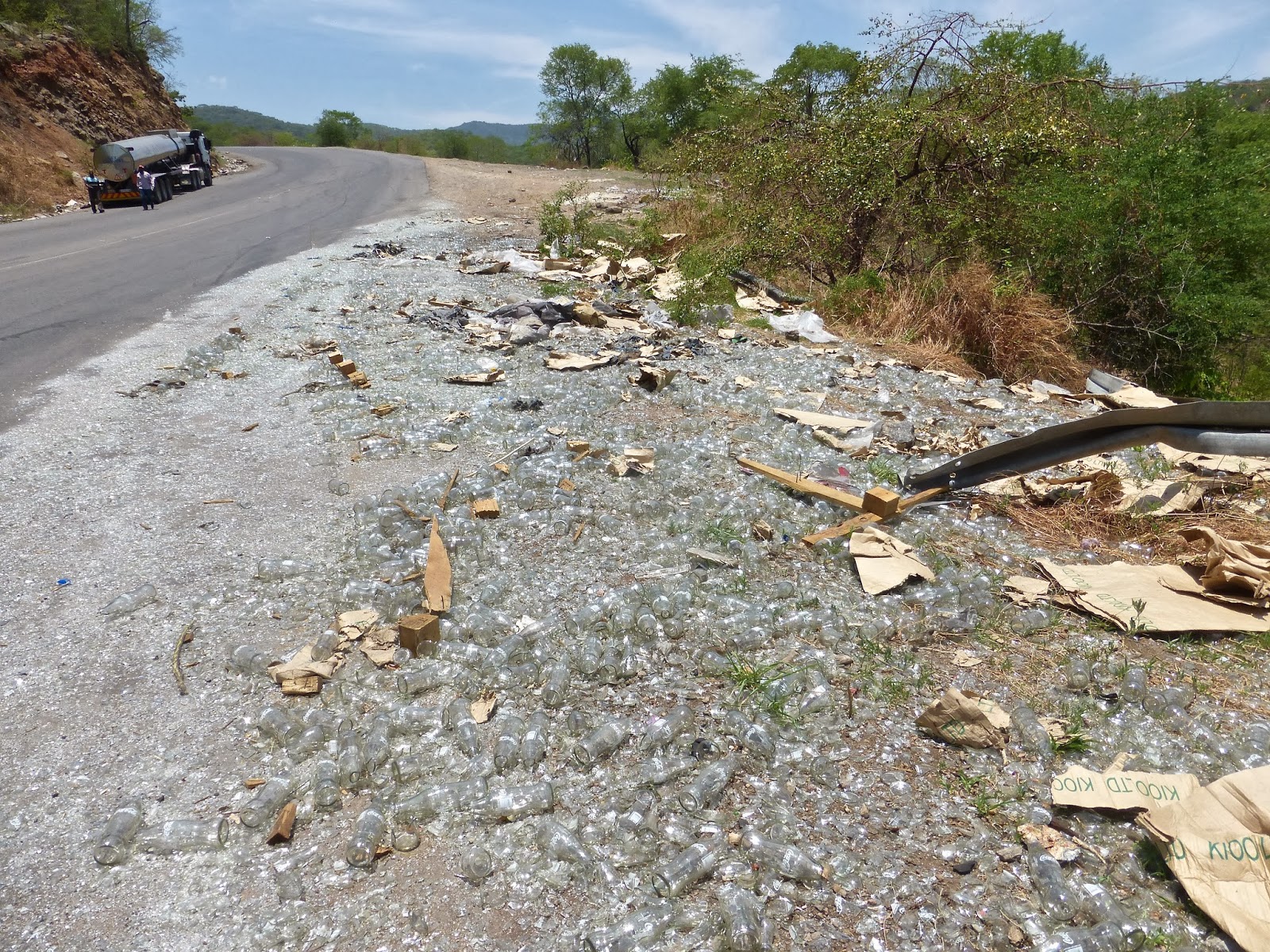

Where these trucks come to a stop there is usually another truck off-loading or perhaps scavenging the load and parts.


Here is a truck almost loaded from the wreck.


Below is a sample of what causes a lot of problems.  The road condition shown here is the same road the previous trucks were on.  I know it looks a lot worse but it actually keeps the traffic slower.  The pot holes are what the trucks and cars are trying to avoid at a high speed.  This is why vehicles are always aiming at you head-on, trying to avoid damage.  Some holes or drop-offs where a shoulder should be could be one or two feet deep.  Is it any wonder why a load would shift?


This truck is moving down the highway.  I knew my truck driving son would appreciate the tires' condition and lack of tires.  This is daylight.  At night the movement is scarier as they know it is dangerous and they think they can not be caught.  They are correct.  Driving at night on an open highway is insane.  We have come home from a long day having to drive the early hours of dark.
No street lights, weaving vehicles coming at you and pedestrians and bicycles along the edge.  Many vehicles have only one light and you don't know if it is the right or left one working.  There are very few motorcycles.

Of course one man's tragedy is another man's fortune.


Some trucks look like an accident but just keep running.


Don't worry we'll fix it right here.


Night driving without any outside lights or reference is tough on these lonely roads.


Once you drift off, you have multiplied your problems.


Sometimes you see trucks and wonder what the other vehicle looks like.


Here are a lot of branches to keep you from running into the stopped truck.


Zambians are very helpful.  If you blow a tire just wait a minute or two and you will have a crowd to help get you on your way.  A nice tip would be helpful but no anger if you don't have anything to spare.  These guys are helpful for another reason.  The pickup they were riding in the back of broke down.  They helped it get up this hill so they could all get back to their jail cells and a nice meal.


The big ditches are always a problem.


After it has been studied a while and a consensus taken the car will get out of the ditch without a tow truck.


I really have endless photos of wrecks.


This is a truck that hit another truck head-on at night, of course no survivors.
This past weekend the news had a bus/truck head-on that looked pretty much like this except the bus was burned and gutted.  It made the news because it killed instantly twelve people and twenty four went to the hospital.  Maybe the dead were the lucky ones?  It happened around two or three in the morning.  NEVER, NEVER get on the highways at night!


Tuesday, January 28, 2014

Metal Workers of Alick Nkhata

Alick Nkhata was a popular Zambian broadcaster and musician.  This road that is named for him runs in front of the area known as Mass Media or the hub of Zambian broadcasting.  We drive down this street everyday.  Other senior missionaries refer to it as the "Home Depot" street.  If you are building a home or repairing one, this is a good place to start looking for supplies.


One group of craftsmen are the metal workers.  Businesses tend to clump together when they have a similar product much like in the U.S.  There are many metal workers in Lusaka, as there is much building going on.  Next to that trade are the tin smiths.  They produce all sizes of tubs and buckets, along with watering cans and many many chicken feeders.


Door and window frames are a staple.


The metal is laid out wherever there is room.  I am amazed that items turn out flat and square.


Mbaula's are produced and sold everywhere.


Perhaps you would like to splurge and get the sink model but I have never seen one used.


Recently, a new billboard appeared in this neighborhood.  The sign encourages the use of new the improved mbaula.  I don't know where you would buy one yet.  They appear to be more efficient and more difficult to make, therefore more time and materials and hence more cost to the consumer.  These are all the same difficult choices we make.  Do we just look out for ourselves or do we sacrifice a little for the good of the community?


Here is a welder producing a special order.


Some welders specialize in playground equipment.
At the end of the day many men congregate here to chat, sitting on slides and swings.  There are not many places to sit along the road otherwise.


Here is a new project just beginning.


Lately, there have been quite a few water towers for tanks made.
It wasn't placed next to the road.  It was made right there and painted there.


Many people help when it is delivery time and a truck needs to be loaded.
I believe only the main crew of three are going to get paid anything but people are very helpful and very happy for others' good fortune.


Here is a typical shop that does a little of everything.


Most of the metal workers have a storage container to store the raw materials in.
At first I couldn't understand why they would point them at the road.  Every time a 20 foot piece of rebar or angle iron is removed, traffic must stop.  I thought, this is ridiculous.  Now I realize the property they work on is only 20 feet deep.  This makes for a little inconvenience but optimal use of the space they have.


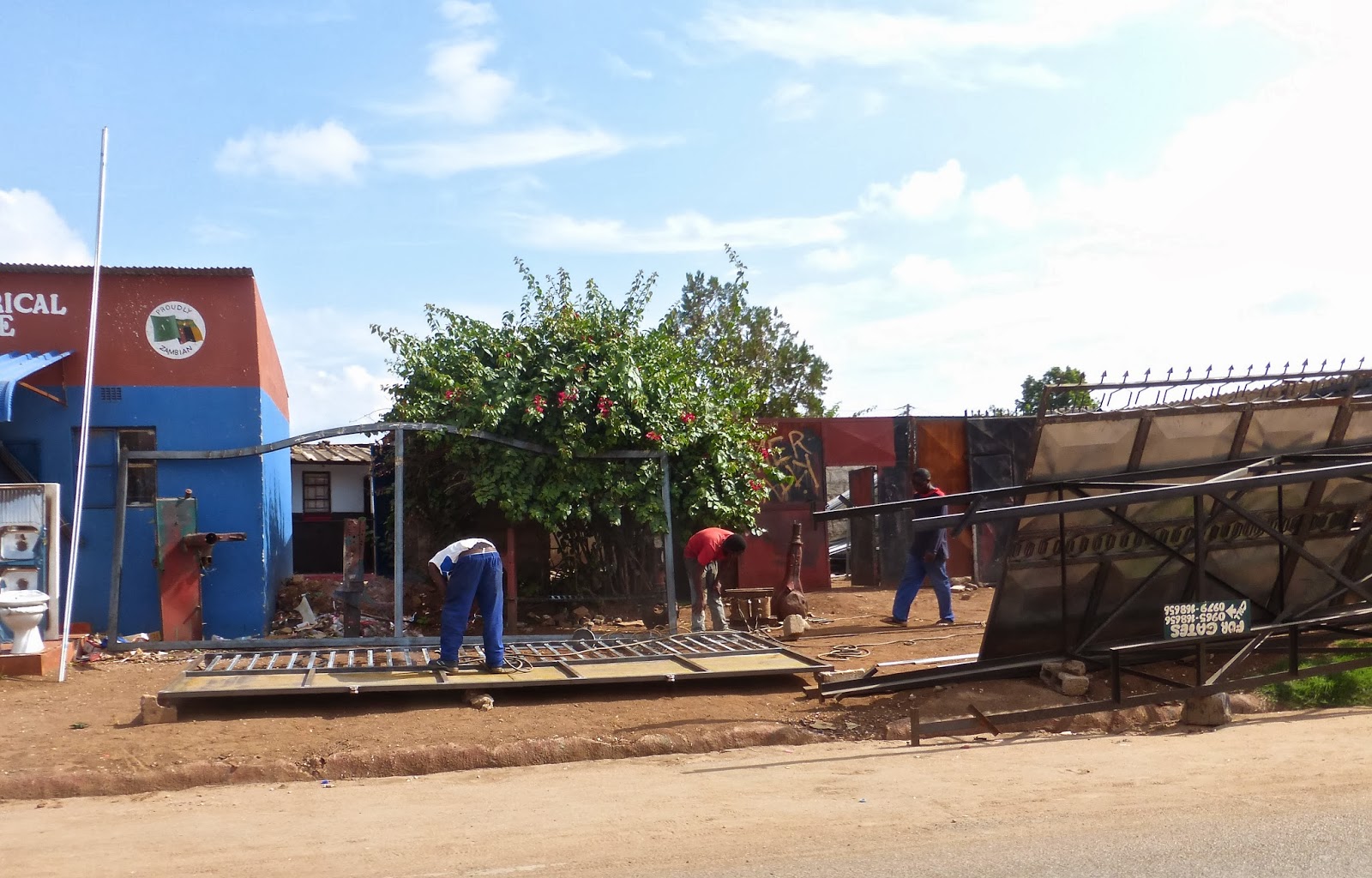
Gates are a big business.  Here is where a metal worker can show off his artistic skills.


I do worry about them being propped up with just one board and kids playing around them.
When I got out and chatted with them one day I noticed they were mostly propped up with metal and it was driven into the ground.  But still ….


Wherever there is room, commerce takes place.


A gate installed will run you about $ 1200 US dollars for a simple one to about $ 2000 for the most intricate design depending on how much steel is used.


There are a lot of funny signs around and made funnier to me by the misspellings.  I believe Xavier was a catholic saint.  I don't think even the Catholics would understand what is meant by "Ex Savior".  


Window bars or grills.


Different designs.


Most stands are wood and cardboard but one metal worker is now putting out all metal shops.  This one is quite futuristic but lately the more traditional square with overhangs for the rain are being made.


That is a lot of heavy steel to be packing!


One grinder and one electric welder and you are in business - as long as the electricity stays on.


New project being laid out.


This one is ready to go.


More options.


This is the type of home made welder that everyone uses.  I have never seen acetylene bottles.


Do you think that looks a little dangerous?  Remember it rains often and hard and there are BIG puddles!


Another layout.


I asked if I could see their welding glasses.  They are just normal sunglasses and none of them were as dark as mine.  What sort of vision will they have in twenty or even ten years?


I never walk in the footprint of these traps.


So life goes on, on Alick Nkhata road.  Hard work, six days a week, some beer and music on weekends.  Slowly, the family improves its' circumstances, but perhaps the welder will have to change careers because of damaged retinas?


I must look for welding goggles and convince them to wear them.
If anyone has an extra box - please send them over.


Wednesday, January 22, 2014

Rain in Zambia

Last year I was anticipating the rainy season and wondered if all the ditches would be full.
This wet season is not like I expected.  The weather here has been extremely pleasant.
There are clouds around on most days now, but plenty of blue sky.  Most days there is a sprinkle of rain or perhaps a ten minute soak but that compromises the bulk of the moisture that is so essential for all the small gardens to grow.  Occasionally there is an exception and the big "thunder bumper" cumulus nimbus clouds form with accompanying lightning and we know we are in for a treat.


When it comes, preceded by a little wind, it is like someone is holding a garden hose on your windshield and the wipers have no effect.


Here a couple of photos from driving home the other day.


Yesterday it was so loud, Kristi and I went out on the porch of the mission home and just watched it flow and erode the street in front.


We were using separate cars so when I was ready to leave, the gate guard, Jackson, was ready to head home.  It was torrential so I offered to take him home.  I get to speak with Jackson several times a day as I go in and out running errands.  He also calls me when the post or Fed Ex or DHL arrives, so we chat often.  I had forgotten he had a bike, so he put that in the back of the truck and he showed me where he lives.  It is no more than two miles from the mission home.


By the time we were half way there the rain was easing up, but the streets still had lots of water that needed a place to go.


As we drove down through Jackson's village, I asked him how the locals felt about having their pictures taken.  He said it wasn't a problem, so I handed him my camera and asked if he would take some. You will notice that the ground is fairly dry already.  This is within ten minutes of the downpour.


Jackson's timing wasn't that good with the camera but you can see that a little mud doesn't deter anyone.


Everything had been covered up and now was being uncovered to resume business.


The corn lady had an umbrella, but the fish lady just seemed to keep on cooking.


Jackson very graciously invited me into his home to meet his wife.
This is the outside of Jackson's home.  The door leads to one room.  There is a curtain of three blankets that separates the bedroom from the front room.  The little girl is a neighbor.  That is Jackson's fine bicycle that he keeps inside.  The white cloth is to keep the flies out when the door is open for some circulation of air.


Here is Jackson in front of all his worldly possessions.  They have a one burner hot plate on the left, two buckets of clean water and several jugs of water, a TV and music system and a sign made from beans that says, "Jesus Never Fails".


This home was probably the cleanest one I had been in.  It took a little while for Precious, his wife, to appear from behind the curtain as I think she was putting on some very clean clothes.


I pay the security company that pays Jackson.  The company gets 1300 kwacha for his monthly shift of twelve hours, six days a week.  If he were to get 1200 of that, that would work out to about 46 kwacha a day or less that is 4 kwacha an hour or .72 cents an hour.  He probably receives closer to 200 US dollars for the 312 working hours a month with only Wednesdays off.

Does he look happy?  How about Precious?  Is she happy? 
 Honestly, money does not make people happy. 

It is our life's work to figure out where real joy comes from.