This is a quote from "Hillel the Elder" from the first century. (I thought I was so original!)

Thursday, October 31, 2013

Reed Furniture Makers

This type of reed furniture is sold along the streets of Lusaka


At first I thought it was imported from somewhere.


There are only about three basic styles


It wasn't long before I noticed a fellow behind the inventory working away.


I have only seen men making reed furniture.


Some styles are very stiff and square, some have a few more curves.
This type of furniture is made from a smaller round reed.
The weaving is quite fine.  It takes two to three days to make a chair and five days for a couch.


The darker color is achieved by applying a stain/varnish.
On one corner near our house is a group of men from near Kitwe to the north.
Just to the west of Kitwe is a large swamp/lake that provides most of the reeds used.


These items are made with a wider reed and they tend to make more bookcase and dresser type items.


They worked very fast while I chatted with them.  There fingers were blurs and it took a lot of concentration and strength to keep everything even and continuous with reeds stopping and starting.


Frame and seat can be completed in a day.


Once we showed we were really interested in their work they were happy to share it with us, even though we weren't buyers that day.


I would think that selling cushions at the same place would increase their profits but no one does.
First of all no women are involved and trying to keep them dry and clean in that environment would be almost impossible.


These are some of the basic raw materials.


Here a simple bookcase is being created.  We have a couple of these in our home and so do most of the missionaries.


This area is a little more upscale so there are dog beds available too.


They also make chicken coops.  They are just small little houses that have a ramp up to the door.
This guy is making rabbit nesting boxes.


We broke down and bought a chair for the bedroom.  The cost was less than $50 USD and probably took three days to make.  With the cost and labor of procuring the raw materials it works out to less than $2 per hour.


The new chair in our bedroom allows me to more easily put on and tie my shoes and we can now get away from each other and read quietly in another room.  Maybe the honeymoon is over?


Last, I thought I would show you the other type of sofa/chair sets that are sold here.  This is what is in most of the homes I have visited.  The stuffing seems to come out quickly and it isn't long before you are on thread bare cloth on boards.  It seems once furniture is placed in a home it stays forever.  I think it would take a fire for them to get rid of it.  You can find hundreds of these in one place or another.


Tuesday, October 22, 2013

Chimpanzees in Zambia?

Chimpanzees are not native to Zambia.  They are mostly found to the north in the DRC or Democratic Republic of Congo.  Sheila Siddle came to Zambia from England as a teenager with her parents in 1947, the year I was born.  She married and raised a family on a ranch far out in the bush just south of the DRC border in Zambia on the Kafue River.

The first chimpanzee arrived when her son brought home an injured baby.  It was so young that Sheila had to develop a milk formula and then food to keep it alive.  When smugglers were caught with a baby chimpanzee trying to cross the border, she was asked if she would take care of that one too until the authorities could decide what to do with it.  Thus a lifetime of care for chimpanzees began.


She is now 82 years old and still caring for orphaned baby chimpanzees along with those that have grown up but could not be released or relocated.


I had read about her place so we made it a point to take a day and drive out to her orphanage.  It is a large non-profit organization now that has a farm to help support the chimpanzees and the village of workers that make the place function.

We felt honored to be able to meet her when we traveled from the main camp out to her home.  She invited us in and shared with us her latest orphan, "Juel", a son of "Jewel" that had died in childbirth.
Sheila Siddle was an interesting person who had seen many things while living in the bush.  Her husband had died a few years before, so the responsibility was now all hers and one daughter.


She had also raised a baby hippo that wandered around her property and the river as he got older.  Her photos of "Billy" the hippo were fascinating as we purused the family albums of Billy in the house and even on the couch.  He eventually couldn't make it through the door, so remained outside.  Billy was just twenty years old when he died last year and she was still very sorry for the loss of her friend.

Sheila has several compounds of chimpanzee families that were fascinating to observe.
I could easily spend a day watching the interaction and personalities.


Chimpanzees are the closest animal related to humans.
That is probably why they are so interesting to watch.

Sometimes, as they get old and strong and dominate, they can't get along with anyone else.
I am starting to relate to these guys and wonder if my kids will get ideas when they see these photos.


This is what happens to cranky old men when they can't get along.


I many be in trouble.
I do like salad quite a bit though.


I must remember to behave so I can just wander around my 100 hectares like everyone else.


I related especially well with this kind gentleman below.  He is exactly 66 years old, same as me.
Can you imagine the powerful golf swing with those arms?
Of course he would have to stand on a box, but I might have to one day too if I don't quit shrinking.


This fellow and I just wondered what the other ones life was like.
I loved imitating them - or were they imitating me?


These two "silver tops" just chattered away all day and ignored the males.


This group had acres and acres of territory but when the keeper came around with crackers they were right there showing us who was the dominant one and what kind of manners they had learned.


There are very specific noises and gestures that their keeper can interpret in their communication.


It was fun to see them as free as they could be.


Each one was totally unique in looks and personality.


This fellow was the current alpha male and everyone was very attentive to him.
I tried to get a few pointers but we had to move on and didn't have time to refine his techniques.


Back at Sheila's house little Juel had all the comforts.  Sleeping in a crib, fed from a bottle, held a lot of the time and even a panda and Mickey to play with.


I had always envied late night talk hosts, in that they get to play with a lot of exotic baby animals.
Of course they show the clip of Johnny Carson and a chimpanzee over and over.
I was happy to have that experience and even play with Jeul longer than Johnny did.


Kristi's motherly instincts came out and I think she had flashbacks to at least one of our kids.
I'll let them figure out which one of the five she was visualizing.


Copperbelt

The Copperbelt is an area on the northern left lobe of Zambia.  It is also the name of the district or "state" that comprises that area of natural copper resources.  The DRC or Democratic Republic of the Congo is that little chunk that seems to split Zambia that is also full of copper and the Zambians lost it to the northern country, not with fighting but with politics, many years ago.  The area is Zambia's greatest source of wealth.  Zambia is always complaining about the natural resources being exploited by other countries and not staying in Zambia.

The mission president sent us up to the Copperbelt for a visit.  It is one third of our mission, so it was nice to be able to see what everyone was talking about and what the flats or apartments looked like that I paid the rents on.

These are some of the photos I took on this four day tour.

First of all, Lusaka beer heading north.  Those are not milk cartons but containers of beer.


Once out of the city, life is VERY rural.


The small town market places look much like the big city markets.


This is a typical city outside the capital.  This is Kabwe's main street.


Along the paved highway are vendors.  Here was an area that specialized in gourds.  Charcoal and fruit and vegetables are the most common.


The termite mounds are everywhere but different species build them higher.  Some are quite impressive.


We stayed in a flat that the mission just leased for visitors.  It is located next to the sisters' flat and has a guard at night.  It was brand new so it was surprising to see the quality of workmanship.  You can see in this photo the light coming in alongside the panel and under the door.  It was actually much worse than the photo.


There was a Zone meeting while we were there so we got in our first photo with missionaries after four months.  It is so nice to be able to be around the missionaries and feel of their energy and spirit.


We hung out with a senior couple who live in the Copperbelt, the Harveys.
They showed us around town and the location of the various churches and missionary flats.


Here, they took us to a village called Kawama.  It was like a step back in time.


This is a common site.  It is a game that is played a little like mancela.  The holes are to be found in most yards where folks sit on the ground and play moving stones from one "cup" to another very quickly. 


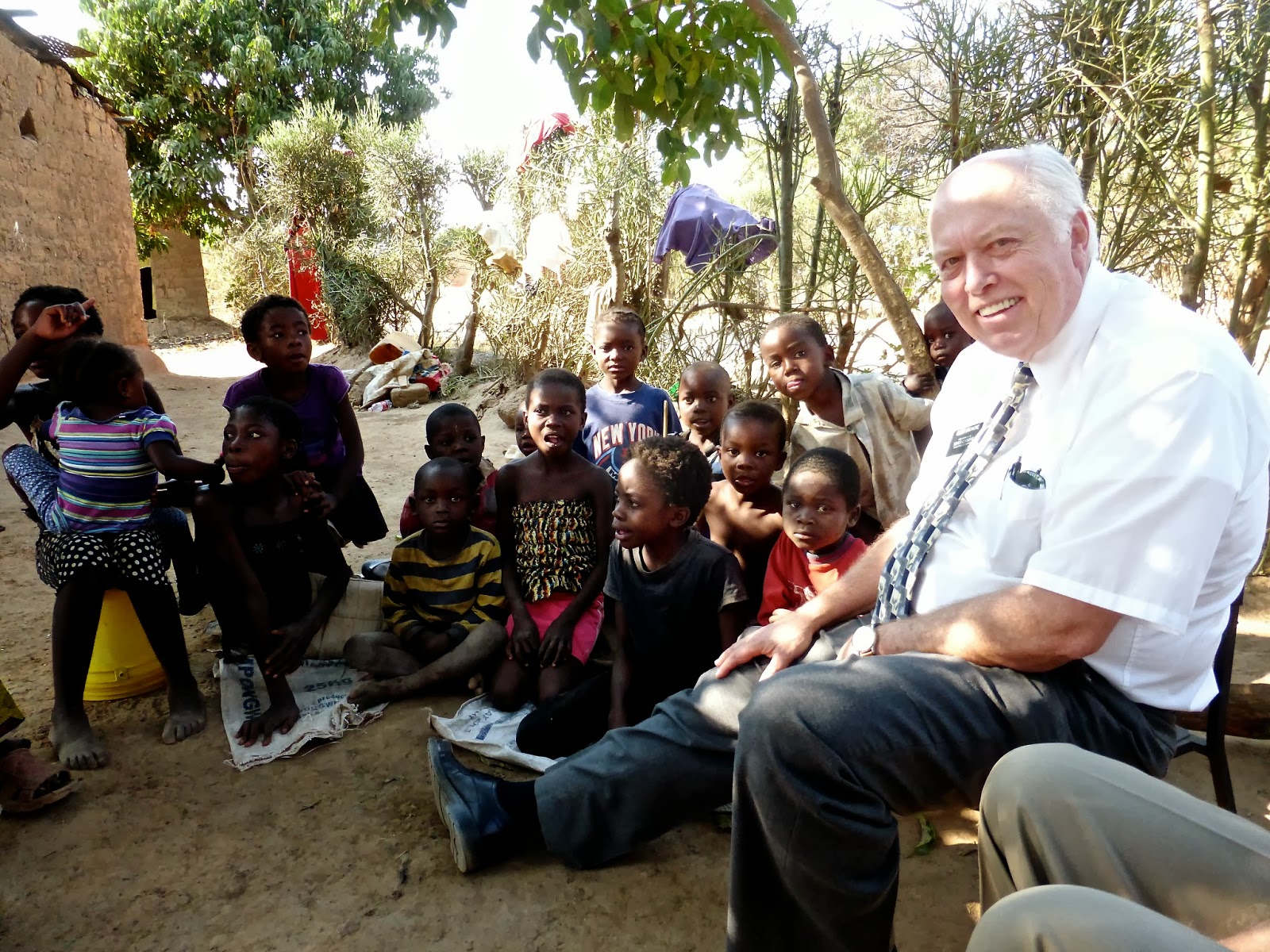
We were introduced to the Primary President and then a lot of children gathered and Sister Harvey related a story to them.  They were enthralled with her story telling and our visit.


We had to have our photo taken and wouldn't have if I thought they would be the least offended but everyone seemed to enjoy it.


This is the Harveys' last week in Zambia and I am sure they are having a difficult time saying goodbye to their many friends.


I am always fascinated with what women need to clean and what can be let go.


Elder Harvey was having a chat with the father of the family.


I just liked the next few photo that look representative of what goes on outside the big city.


These kids loved holding Elder Harvey's hands on the way out.  They kept feeling his hairy arms.
He looks like the Pied Piper.


Everyone was so friendly.  The parasols were coming out as the temperature was heating up.


This roadside stand was just northwest of Ndola.  It is the first time I have seen an abundance of art work displayed.  I would have liked to stop and chat about the materials they used and where they got it.


These are rugs made from rags and tied together.


We saw lots of evidence of mining in the north.  There are many open pit copper mines and slag heaps from the smelters.  We followed this truck on the way south again.  He is carrying big ingots of raw copper, the wealth of Zambia.


Sunday, October 20, 2013

I couldn't take a photo.

I love to take photos.  I try to paint sometimes and sometimes I look at the lighting and composition and wish I could capture what I see and what I am feeling.  Yesterday I got to go with Elder Hontyo from South Africa to meet with some families he was teaching because his companion was ill.  I was happy to go.  It is a pleasure to meet with such nice people and share gospel truths with each other so openly.

Let me describe what I saw.  Elder Hontyo doesn't drive so I drove to a member's home where we inched down an alley and just before it narrowed to three feet, a gate was opened and I drove into a nice  paved compound home and parked the truck.  The area was small but neat, and a nice ten foot by ten foot patch of grass set everything off nicely.  There were lots of potted plants around.  Two women were seated on the ground washing a pile of clothes that reached almost as high as their shoulders.  They each had a large plastic tub and were chatting and scrubbing away.  I thought they were the women of the house, perhaps a mother and grandmother.  I introduced myself but apparently they were not related and happy to keep washing.  Next we went inside and Elder Hontyo asked the children ages eight to fifteen, who would like to go teaching with us to the neighbor.  The Elders have guidelines that they shouldn't teach single women without a local member with them.  I never saw the parents.  First one and then another volunteered and we all walked out the gate and continued the rest of the way down the alley to Memory's home.  Memory had been expecting us and we had a good discussion about what she had been reading.  Elder Hontyo was very direct and patient with all of us.  I picked up on his cues to me and contributed what I could.  Her home was small with a high ceiling of perhaps ten feet.  The walls were grey, raw plaster and the ceiling was the underside of the corrugated tin roof.  Nothing on the walls and she had furniture that was mostly just fabric on boards.

What would I have taken a photo of?  Two things here really stood out to me, I hope I can remember them for some time.  First was the grandmotherly women washing.  They sat on the ground and were so colorful with the piles of clothes, their own clothes and head coverings, the tubs of low suds, and their happy, chatting friendship.  There was greenery and sunshine.  I just wanted to capture that and then learn more about them and their daily lives and past experiences.

The second photo would have been one of Memory and Elder Hontyo.  The room was dim as are most smaller homes.  The colors were non existent.  Greys and browns and muted reds all blended so perfectly and then if I could capture them, I would have Memory's eyes sparkle as brightly as I saw them in that dim room.

Now this is my blog so I get to tell you of one more photo I would have loved to take yesterday.  Elder Hontyo took me to meet Laurence and his family yesterday too.  Laurence is married with two children.  He lives inside a very nice compound where there are seven flats or houses that are leased out.  He is one of the gardeners and handymen for them.  These houses are small compared to the large home at the rear of the compound.  This was once a grand estate.  The grounds were like a park. The driveway is lined with white pillars among the greenery that meandered back to the main house.  Paths and sculptures, grass and huge trees made the place very inviting,  a secret garden.  Laurence met us at the main gate and walked us down one of the pleasant paths to a door in a freshly whitewashed wall.  Inside was dirt.  Not a blade of grass.  Fresh dog poop, which I haven't seen much of, and a single water tap over a two foot square brick pad, and then mud.

There were four doors to homes facing us but we went around to the back where there were three more front doors.  Laurence's home is the middle door.  His young wife was seated on a couple of rocks while washing clothes in two basins on the ground.  Young son Laurence Jr. was just playing with sticks in the dirt.  Inside I met Sarah his daughter, probably seven years old, and Laurence's brother who was watching an action DVD.  Laurence's younger brother had just come to the big city from a village about 100 km to the east for a four day visit.  He'll be here over Independence Day.  He was able to get a ride in the back of a truck.  Sarah was dressed in a clean but very old, worn, and a little tattered school uniform.

The TV went off and the family gathered to hear what Elder Hontyo had to say.  Laurence had been reading and praying and seemed eager to learn more.  (Today I walked off in our home how big these rooms really are).  Laurence's room was approximately six but no more than seven feet wide and nine or ten feet long including the doorways.  Worn and tattered furniture lined the long walls.  At one end was shelves made of wooden boxes.  These contained all the kitchen items and TV and a couple of books and other boxes.  (These rooms always remind me of a twelve year old boys club house in America, made up of items scrounged from around the neighborhood in my youth).  On the floor of the opposite wall sat a small two burner hot plate about six inches off the ground.  A low coffee table appeared to be their only table and left just enough room for legs between couch and table.

What really fascinated me was little Sarah squeezing by, back and forth, quietly listening while she prepared her lunch as her school was to start in 45 minutes at noon.  (Public schools are another issue, with three sessions a day and anywhere from 60 to 100 students in a class.  Yes a class, not a grade.)

Sarah measured out the maize and put it in the little bit of boiling water and stirred.  She also measured out some sort of drink and poured hot water from the tea kettle in her cup.  I didn't see any relish but there must have been something as plain nshima is tasteless and without much nourishment at all.

What did I want to take a photo of?  That hot plate sitting on the concrete.  It sat against the plain grey wall with a cooking pot steaming and scrubbed as clean as I had scrubbed pots in scouts with sand used for a brillo pad.  Next to the pot was a silver aluminum teapot scrubbed with a resulting patina much like silver, topped with a dull red knob.  How could I capture that multitude of warm greys with some black and touches of highlight on film or with paint?  The greys were all made warm by the sunlight streaming through the doorway.  Some "still life's" take on more meaning to the painter or photographer than others.  I would include the two wires protruding from the wall about two feet from the ground.  The wires were bent out and up.  There was a matching set from the hot plate with the bends reversed so they could be hooked together by gravity.  I had seen construction workers cook lunch this way but I was amazed that such a dangerous situation was allowed around such young people.  Sarah's dad reminded her to "switch off" the "stove" after removing the pot.  She simply lifted the wires from the protruding ones.

Why did I want to remember this scene?  I believe that the gospel of Jesus Christ can take people out of poverty quicker than anything else and the results are more lasting.  Yesterday I heard Elder Edward Dube speak from Salt Lake City to the whole world about "not looking back but looking forward.  Elder Dube, not too long ago was also a "garden boy" but in Zimbabwe, just to the south.  He, like many others put eternal truths to work and relied on the atonement of Jesus Christ as he marked out his life.  Along with providing for his family he eventually served as the Stake President and then mission president over Zimbabwe and Zambia.

Life can be easier and more comfortable for Laurence and his wife and they in turn will be able to bless the lives of many people by sharing these same eternal truths.


OK - You've read this far I will throw in two bonus photos:

This is a very red tree.  They have been popping out in color all over town, now the purple jacaranda trees are almost gone to leaf and the heat is turning up.  We have been calling them flame trees but we think now they are called "flamboyant trees."


These are the four elders that live in Libala.  We were meeting them at the church and we could see the four white shirts coming towards us from blocks away.  The truck windshield distorted them a little.